Monday morning, three weeks before the highlight of the season: the rights holder sends a stack of ticket PDFs, the field sales team asks for seats by email, and the allocation list exists in three versions. Anyone sending invitations now is working with information that is already out of date.
Corporate hospitality software solves exactly this problem: it manages ticket allocations centrally, distributes invitations through the hosts in your company and tracks every seat all the way to the entrance. In this guide you will learn the six criteria that tell you whether a solution fits your programme. It is written for sponsorship and hospitality managers as well as event teams in companies and associations.
At a glance
- What it is: Corporate hospitality software manages ticket allocations from sponsorships, distributes them to internal hosts and accompanies every guest from the invitation to check-in.
- Where it breaks: The real problem is the gap between spreadsheets, inboxes and PDF folders. According to the ICE Annual Benchmarking Report 2025, 75% of corporate event teams still use spreadsheets alongside their event technology.
- The six criteria: Roles and permissions, allocation logic, ticket formats, guest communication, data flow and security.
- Why integration matters: According to Forrester (2026), 62% of deeply integrated organisations are satisfied with their event performance, compared with 37% of those without integration.
- How to start: With a pilot for one event, a few sponsors and a few hosts. It shows you faster than any concept where your process loses seats.
What is corporate hospitality software?
Corporate hospitality software is software that companies and associations use to manage ticket allocations for sports, cultural and business events, distribute them to internal hosts and accompany their guests from the invitation to check-in. It connects allocation, guest, ticket and entry in a single record.
The term is often confused. Anyone searching for “hospitality software” quickly ends up with hotel and restaurant systems. What we mean here is something else: allocating seats in VIP boxes, business seats and hospitality packages to customers, partners and employees.
| Software type | What it is for | How the ticket is created |
|---|---|---|
| Hotel and restaurant software (PMS) | Rooms, reservations, point of sale | Booking by the guest |
| Ticketing platform | Selling tickets to a broad audience | Purchase |
| Event management software | Planning your own events, registrations, check-in | Registration |
| Corporate hospitality software | Allocating sponsorship tickets, inviting guests, proving utilisation | Invitation by a host |
The key difference is in the last column. Hospitality seats are not sold, they are allocated. A hospitality ticket belongs to a person with a name, a history and a contact person in your own company. That is why, in hospitality, what matters most is the quality of each individual invitation.
How big is the topic?
According to the ESA Sponsorship Market Overview 2026 by Nielsen Sports, the European sponsorship market reached 34.45 billion euros in 2025, up 4.7% on the previous year. 72% of that goes to sport. In Switzerland, according to the ZHAW study “Sponsor Visions Schweiz 2022”, 60% of the companies surveyed were active in sports hospitality sponsorship (data from 2021). Behind each of these commitments are allocations that someone has to distribute.
The distribution chain: from ticket issuer to guest
An allocation rarely goes straight to a guest. It passes through several stages, and each stage has its own interests, tools and deadlines:
- Ticket issuer (external) issues tickets as PDFs, codes or access credentials.
- Organiser or rights holder (for example an association) allocates tickets to sponsors.
- Sponsor holds the allocation and distributes it internally.
- Hosts in field sales, regions or departments choose their guests.
- Guests and their companions receive the invitation and the ticket.
One contract turns into hundreds of individual decisions. Why expensive sponsorship experiences fail precisely along this chain is explained in our article on the paradox of event sponsorship and hospitality management.

Why are spreadsheets and email no longer enough for hospitality allocations?
Spreadsheets and email stop being enough as soon as several people work on the same allocations. Copies appear, and each copy becomes its own version of the truth. The real problem is the gap between spreadsheet, inbox, PDF folder and the list at the entrance.
How common this is shows in the ICE Annual Benchmarking Report 2025: 75% of the corporate event teams surveyed still use spreadsheets alongside their event platforms. The report was produced with the support of software vendor Cvent, so the figure is vendor-related. Spreadsheets have not disappeared for lack of technology. They remain because technology often covers only part of the process.
Then there is the organisation. According to the Forrester State of B2B Events Survey 2025, field teams organise the majority of events in 31% of the largest companies. And 28% of the largest organisations use six or more event platforms. The more teams and tools are involved, the more handovers there are, and every handover is a point where information gets lost.
Three structural reasons
- No shared status. Anyone who books or returns an allocation only changes their own version of the list.
- No link to the guest. The allocation sits in a file, the invitation in an inbox, the ticket in a folder. People connect them by hand.
- No role logic. Giving field sales access to the full list is risky. Giving them none is slow. A spreadsheet only knows these two options.
Data protection adds to this: multiple copies of guest lists make access requests and deletion harder.
Where the hospitality cycle typically breaks
| Step | Typical break point without an end-to-end system |
|---|---|
| 1. Allocate | Allocation lists in spreadsheets, only one person has the current version |
| 2. Distribute | Requests by email, returns and rebookings get lost |
| 3. Invite | Manual mass emails, not sent in the host's name |
| 4. Register | Rigid standard forms, companions and preferences are missing |
| 5. Deliver | PDF tickets named and sent by hand, mix-ups |
| 6. Entry | Paper lists, checking names at the entrance |
| 7. Evaluate | Data from three sources has to be merged afterwards |
Source: evenito white paper “From allocation to guest” (2026), editorial compilation, no measured error rates.
How large such chains become in practice is shown by evenito customer projects: at AXA, four locations, more than ten ticket coordinators and more than 50 field sales employees share one allocation for “Art on Ice”. At AMAG, more than 450 dealerships book and distribute tickets according to a centrally defined set of rules. You can read more about the typical consequences in our article on chaos in attendee management without event management software.
Which 6 criteria must corporate hospitality software meet?
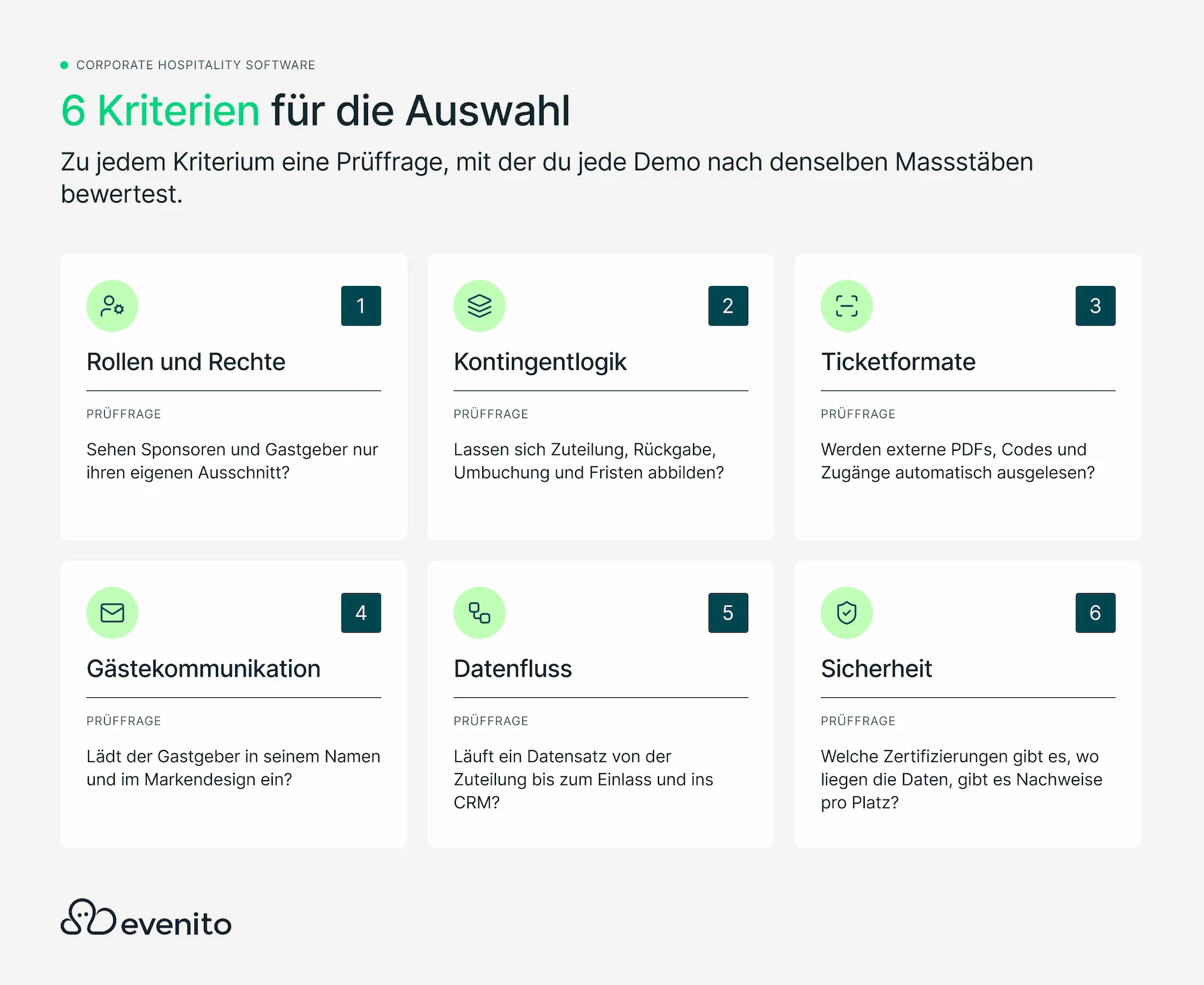
Corporate hospitality software has to do six things: separate roles and permissions cleanly, map allocations, process all ticket formats, invite guests in the host's name, carry data through to the entrance and meet enterprise security standards. The criteria come from our white paper “From allocation to guest”. They are an editorial checklist based on project experience, not a study.
For each criterion you will find a question to ask in the demo and a warning sign to watch out for.
1. Roles and permissions: who sees what and who can do what?
Good hospitality software shows each role exactly its own part. The organiser sees all allocations, the sponsor sees its own, and the host in field sales sees only their share and their guests.
This is the basis of the model that works in practice: allocations, deadlines and brand presence are managed centrally, while choosing guests and sending the personal invitation stay with the people who own the customer relationship. Forrester supports central management with data from the State of B2B Events Survey 2025:
“When a centralized team runs the majority of the events, overall event satisfaction levels rise significantly.”
– Conrad Mills, Principal Analyst, Forrester (2025)
- Demo question: Do sponsors and hosts see only their own part, and can a host delegate tasks to sub-hosts?
- Warning sign: There are only “admin” and “user” roles. Then field sales either sees everything or nothing.
2. Allocation logic: how are seats allocated, returned and reassigned?
The software must map allocations across several levels, with deadlines, returns and rebookings. A simplified example with made-up numbers: an organiser allocates 1,000 tickets. Sponsor A receives 200 of them and passes them on: 25 to advisor 1, 25 to advisor 2 and the rest to other teams.
What matters is what happens when a host does not use their seats. Without deadlines and returns, they go unused. With clear guardrails, they flow back in time and can be reassigned.
- Demo question: Can allocation, returns, rebooking and booking deadlines be set per ticket type?
- Warning sign: Allocations are maintained as a simple number. Nobody can see in real time who has already assigned how many seats.
3. Ticket formats: can the software handle tickets from external issuers?
Hospitality tickets rarely come from your own system. They arrive as PDFs, codes or access credentials, often from the rights holder's ticketing partner. A good solution reads these tickets automatically, assigns them to a seat and a guest and delivers them.
Without this function, someone names every PDF by hand and sends it individually. That takes time and leads to mix-ups, especially shortly before the event. How sports organisations distribute tickets globally and invite guests locally is shown in our article on ticket management in sports.
- Demo question: Can I upload a batch of external ticket PDFs, and are they read and assigned automatically?
- Warning sign: The software only processes tickets it generates itself.
4. Guest communication: does the invitation come from the right person?
The guest does not see a process, they see an invitation. It should come in the name of the person who knows them, appear in the brand's design and lead straight to confirmation and ticket. An anonymous PDF in a mass email makes even the best experience look careless.
Personalisation usually fails because of data. According to Forrester (2026), fewer than a quarter of the organisations surveyed use AI for personalised attendee experiences, and 63% name data quality and access as a hurdle. Personalisation therefore starts with clean guest data.
- Demo question: Can the host send invitations in their own name and in the brand design, and can guests add companions and preferences themselves?
- Warning sign: All invitations come from a central no-reply address with standard text.
5. Data flow: does the same record run all the way to the entrance?
Allocation, invitation, ticket and check-in belong in one record per guest. Only then can you see, without extra work, which seat went to whom, who confirmed and who actually came. This includes connecting existing systems such as CRM, single sign-on (SSO) and ticketing.
That integration pays off is shown by Forrester (2026): 62% of organisations with a deeply integrated event platform are satisfied with their event performance, compared with 37% without integration. This is a correlation, not proof of cause, but it is a clear signal. How to make event data usable across the company is described in our enterprise guide to event data management.
- Demo question: Can I see in real time which tickets are personalised, confirmed and checked in, and can this be transferred to the CRM?
- Warning sign: Entry and reporting run in a separate tool, and the data is merged via export.
6. Security, data protection and audit trail: does the software meet enterprise standards?
Hospitality programmes process personal data of customers, partners and sometimes public officials. The software must therefore come with recognised certifications, a fine-grained role model and data protection to enterprise standards. In Switzerland, the revised Data Protection Act (revFADP) has applied since 1 September 2023, and the GDPR also applies to guests from the EU.
Then there is compliance. Invitations to sports and cultural events are a sensitive area, as Switzerland Global Enterprise (2026) points out: benefits must never influence a business decision or create that impression. Where it makes sense, S-GE recommends documenting them in a register. Hospitality software provides this documentation per seat along the way: who invited whom, when and to which event. Clarify which rules apply to your company with your legal or compliance department. This section is not legal advice.
- Demo question: Which certifications does the vendor hold, where is the data stored, and can I prove invitations per guest and event without gaps?
- Warning sign: For security questions, the vendor only refers to its cloud provider.
{{cta}}
How do you compare vendors? The comparison table to fill in
The best way to compare vendors is to run every demo with the same six questions and score the answers straight away. Use the table below. Give each criterion 0 points (not met), 1 point (partly met) or 2 points (fully met).
| Criterion | Demo question | Warning sign | Vendor A | Vendor B | Vendor C |
|---|---|---|---|---|---|
| 1. Roles and permissions | Do sponsors and hosts see only their own part? | Only “admin” and “user” | |||
| 2. Allocation logic | Can allocation, returns, rebooking and deadlines be mapped? | Allocation only as a number | |||
| 3. Ticket formats | Are external PDFs, codes and access credentials read automatically? | Only its own tickets | |||
| 4. Guest communication | Does the host invite in their own name and in the brand design? | Central no-reply address | |||
| 5. Data flow | Does one record run from allocation to entry and into the CRM? | Entry and reporting separate | |||
| 6. Security | Which certifications, where is the data, is there an audit trail per seat? | Only refers to the cloud provider | |||
| Total (max. 12) |
Practical tip: Do not let the vendor show you a standard demo. Bring a real case, for example an allocation with 40 seats, three hosts and a batch of external ticket PDFs. In ten minutes you will see how the software handles your day-to-day work.

How do you measure whether your hospitality programme pays off?
Whether a hospitality programme pays off is shown by the path from allocation to entry. The number of tickets handed out says little on its own. This utilisation cascade shows where seats are left unused: at allocation, at invitation or only at the entrance.
| Stage | What you measure | Typical action when seats are lost |
|---|---|---|
| Allocation | Seats received under contract per event | Compare contract and demand |
| Assigned | Seats assigned to hosts | Tighten deadlines and return rules |
| Personalised | Seats with guest names | Remind hosts before the deadline |
| Confirmed | Confirmed guests | Make the invitation more personal, use a waiting list |
| Checked in | Guests at the entrance | Reminders before the event, refilling seats |
Today, teams mostly measure what is easy. According to the ICE Annual Benchmarking Report 2025, 90% of corporate event teams track registrations and 76% track satisfaction. Only 31% measure revenue attribution and only 19% cost per acquisition.
In sponsorship, the gap is older and well documented. According to ANA and MASB, only 37% of the marketers surveyed have a standardised process for measuring sponsorship ROI, and only 40% write measurement requirements into their contracts (data from 2018). In Switzerland, according to ZHAW (2022), only 9% of companies used automated software systems to measure sponsorship success.
For hospitality this means: if you need to justify the programme to management and finance, you need data at the level of the individual seat. Without that basis, every discussion about impact remains a matter of opinion.
Metrics for a hospitality dashboard
- Assigned, personalised and confirmed seats per sponsor and host
- Tickets not yet personalised before the deadline
- Cancellations and reassigned seats
- Entries and no-shows per event
Transparency note: There is no independent, reliable industry figure for the share of unused hospitality seats. The numbers circulating online mostly come from vendors or individual cases. So establish your own baseline in your first programme. How to improve the last stage of the cascade is shown in our guide on how to reduce no-show rates.

Which 8 questions should you clarify before you start?
Before choosing software, you should clarify your process, because technology does not replace the decision about who may invite and which rules apply. It only makes those decisions enforceable and visible. These eight questions help you capture the current state:
- How many allocations go to how many sponsors and hosts today?
- Who decides on allocation, and who is responsible for utilisation?
- In which formats do tickets arrive, and who processes them?
- Which brand and communication guidelines apply to invitations?
- Which guest data is needed, and how long may it be stored?
- How is utilisation determined today, and when is it available?
- Which systems (CRM, ticketing, SSO) need to be connected?
- Which event is suitable as a pilot?
After that, the best approach is to roll out in five phases:
| Phase | What happens |
|---|---|
| 1. Current-state analysis | Capture events, allocations and stakeholders, find gaps, record a baseline |
| 2. Rules and roles | Define who allocates, who invites and who sees what; guardrails, deadlines and brand guidelines |
| 3. Pilot | Run a manageable event with a few sponsors and hosts, collect feedback |
| 4. Scaling | Add more events, sponsors and regions; templates, training, support channel |
| 5. Measure and improve | Evaluate the utilisation cascade per event, take the insights into the next contract round |
Practical tip: Treat your hosts in field sales like customers. If they avoid the solution, the spreadsheet stays.
How does evenito support hospitality and sponsorship programmes?
evenito is Swiss event management software for large companies and associations. For hospitality and sponsorship, the evenito Sponsoring Hub brings the entire process together in one system: from the organiser releasing tickets to the guest's check-in. The principle behind it: central control, decentralised execution.
How it works
- Event calendar: Sponsors and partners see the events released to them in a calendar, depending on their role.
- Booking page: They book or request allocations themselves, with all event information and ticket types.
- Sponsor dashboard: They manage their allocations and download confirmed tickets as PDFs or codes.
Which function solves which problem
| Function | Problem | Result |
|---|---|---|
| Ticket distribution | Allocations sit in spreadsheets, the status is unclear | Packages and allocations are stored centrally, assigned to sponsors, partners and departments in one system |
| Upload external tickets | PDF tickets are named by hand | Incoming ticket PDFs and lists are read and assigned via an AI interface |
| Guest management and guest lists | Field sales has no secure access | Hosts add their guests themselves and only see their own guest list |
| Online registration | Rigid forms, companions are missing | Invitation and registration in the host's name and in the brand design, with forms per guest group |
| Real-time overview | Nobody knows which seats are assigned | The organiser sees which tickets are personalised and who the final guests are |
| Check-in app and badge printing | Paper lists and name checks at the entrance | Guests are checked in via app at the entrance, badges are generated directly from guest data |
| Reporting | Data from three sources | Automated utilisation reports for stakeholders |
On security: the platform is ISO 27001 certified and, according to the vendor, complies with the GDPR and the revFADP. You will find details in the evenito Security Center.
Customer examples
Information provided by evenito and the companies named, not an independent evaluation.
- Swiss-Ski (association): Sponsors and partners log in and request allocations for ski races and VIP events. Swiss-Ski manages requests, bookings and external tickets centrally in evenito.
- BKW (sponsor, energy): BKW receives allocations from various organisers and makes them available to its field sales team for customer retention. Hosts book tickets and upload contacts, and guests receive their ticket through an on-brand channel. With on-brand event websites, BKW recorded 111% more confirmed guests.
- AXA Switzerland (sponsor, insurance): A central team defines rules, allocations and communication, and regional sales teams distribute tickets independently. The partnership has been running since 2017, with around 500 events and about 100,000 registrations.
You will find more use cases on our page about hospitality allocations for sponsorship events.
Frequently asked questions about corporate hospitality software
What is the difference between corporate hospitality software and ticketing software?
Ticketing software sells tickets to a broad audience. Corporate hospitality software distributes tickets that a company has received through a sponsorship or contract to selected guests. The ticket is created by an invitation, not a purchase. That is why roles, allocations, personal invitations and proof of utilisation are at the centre.
How much does corporate hospitality software cost?
The cost depends on the number of events, sponsors and hosts, on the interfaces you need, such as CRM or SSO, and on the level of support. You will only get reliable comparison figures from concrete offers. Besides the licence, also factor in the rollout: rules, host training and a pilot event.
When is it worth switching from Excel to hospitality software?
Switching pays off as soon as more than one person works on the same allocations or hosts in field sales are supposed to invite guests themselves. That is when copies, follow-up questions and manual reconciliation appear. At the latest when you have to prove to management which seats were used, you need one consistent record.
Can field sales invite guests themselves?
Yes, if the software has a role model. Field sales receives its own allocation, adds its guests and invites them in its own name and in the brand design. The central team sets deadlines, rules and templates and can see at any time which seats are assigned, personalised and confirmed.
How do I handle tickets from the rights holder, such as PDFs or codes?
You upload external tickets to the software in one batch. A good solution reads PDFs, codes and access credentials automatically, assigns them to a seat and a guest and delivers them with the invitation. This removes the need to name each file by hand, and mix-ups shortly before the event become less frequent.
How do I document hospitality invitations for compliance?
The easiest way is one record per guest: who invited whom, when and to which event, including companions and check-in. Hospitality software creates this documentation along the way. Which value limits and approvals apply is set out in your compliance policy. Clarify the rules with your legal or compliance department.
Conclusion: which corporate hospitality software fits your programme?
The right corporate hospitality software meets all six criteria: roles and permissions, allocation logic, ticket formats, guest communication, data flow and security. The most reliable way to find out which solution that is for you is the comparison table, filled in during the demo.
More important than any feature is the process behind it. First clarify who allocates, who invites and who sees what. Then start with a pilot for one event, a few sponsors and a few hosts. And measure the whole cascade from the start, from allocation to entry.
Hospitality seats are relationship capital. Their value is not created in the contract, but in the question of who gets which seat and whether anyone can say at the end what came of it. Hospitality wins when every stage knows the same truth.
From allocation to guest: the white paper for sponsorship and hospitality teams
In the white paper you will find the distribution chain, the “manage centrally, invite locally” model, the utilisation cascade, five practical cases and an implementation framework in five phases.
Download the white paper for free
Want to see how this looks with your own allocations? Bring your sponsorship programme, and we will show you in a demo how allocations, invitations and entry come together in one data flow.