For event managers in large companies, it has never been more complex — and at the same time so crucial — to prove the ROI of their events. With hundreds of events per year, thousands of participants and countless touchpoints, this results in enormous amounts of data.
But all too often, event data management is still understood as pure follow-up and treated as a task that only begins after the event. The real value lies in a holistic approach that uses data strategically across the entire event lifecycle.
Because when implemented correctly, event data management becomes an engine of growth. It enables real-time analytics, personalized participant experiences, well-founded decisions, and predictive event planning.
What is event data management?
Event data management describes the entire process of collecting, structuring, analyzing and activating event data, from registration to follow-up.
The goal is to connect data sources and create a consistent, reliable overall picture from fragmented information. This turns data silos into an intelligent basis for strategic decisions.
From data collection to value creation: Why strategy counts
Many companies are already collecting vast amounts of event data, for example from registration forms, participant surveys, tracking systems or CRM integrations. But there is a decisive difference between “having data” and “using data.” Only when data is contextualized and linked does real added value arise.
An example: A high registration rate is only a success if it is known which target groups actually took part, how long they stayed and what content they consumed. These insights show which topics are really making an impact and which budgets are worthwhile.
That is why event data management not only needs technology, but also a clear strategy:
- Which key figures are really decisive for your company?
- Which data sources reliably provide this information?
- Who is responsible for the quality, maintenance, and interpretation of the data?
Only when these questions have been answered will Event Data Management become more than just a reporting tool. It is becoming a real driver for marketing, sales and customer success.
The five phases of successful event data management
Successful event data management can be divided into five phases:
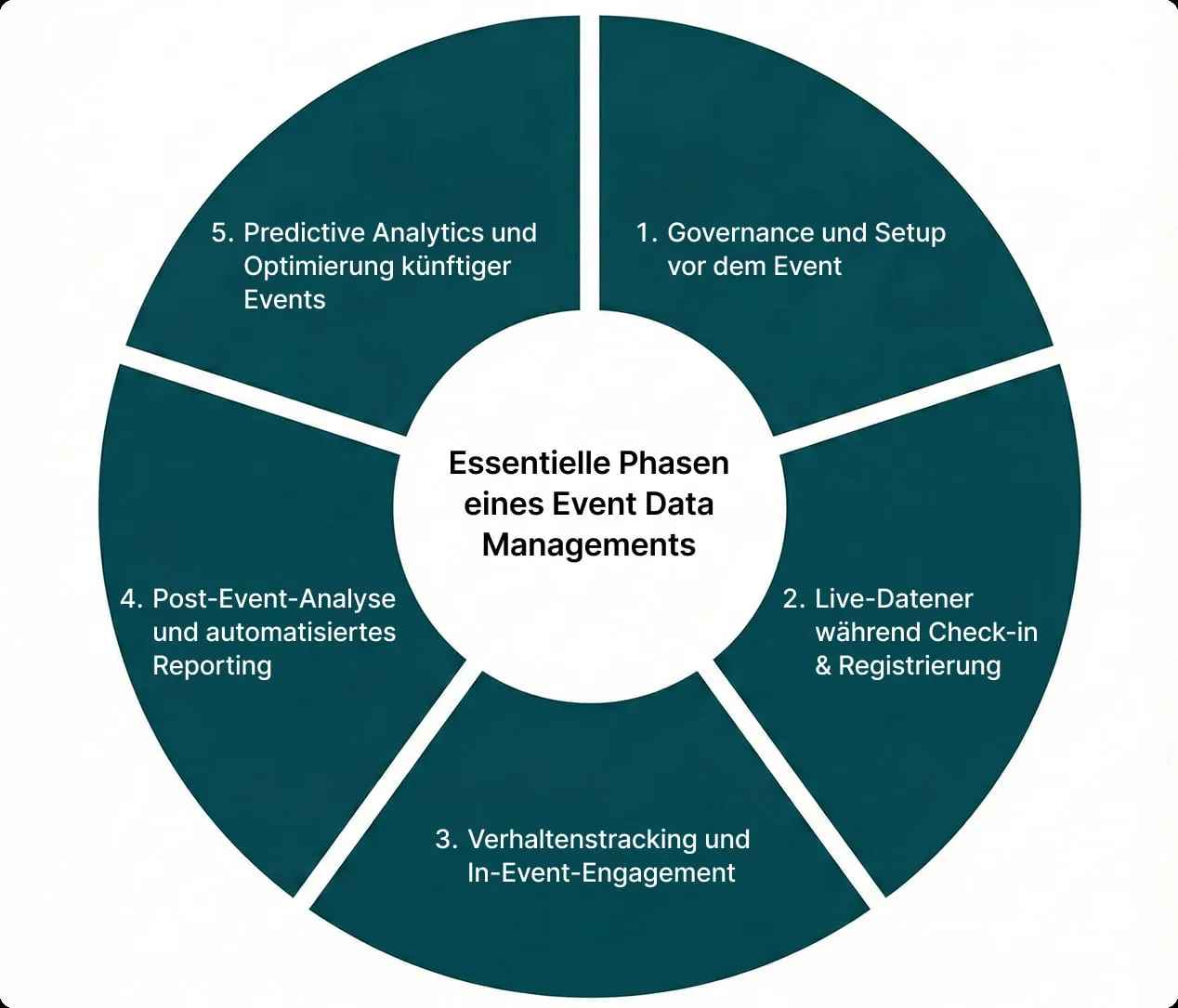
Phase 1: Governance and setup before the event
Enterprise events depend on data quality. Even before the registration opens, clear guidelines for data collection, protection and integration should be defined.
Key steps:
- Uniform naming conventions for sessions and fields
- Integration of event software with CRM, marketing automation and sales systems
- Clear responsibilities and access rights
- Definition of KPIs and reports that ultimately represent business success
This ensures that data is reliable, compliant with data protection regulations and accessible to all teams.
Practical tip: Decide what your dashboards should look like at this stage. Ideally, these are based on existing business goals such as pipeline impact, customer satisfaction, brand recognition or rebooking rate.
Phase 2: Live data collection during registration and check-in
Registration is the first live point of contact and a crucial moment to collect clean data. With a modern event platform, data from participants can be collected smoothly and in real time.
Best practices:
- Progressive profiling: Query only the most necessary data and gradually enrich it later.
- CRM sync in real time: So that marketing and sales can react immediately.
- Smart check-in: QR codes or kiosk systems reduce waiting times and provide immediate attendance data.
Even before the event, heat maps and Engagement scores help identify interests, such as which sessions are bookmarked most frequently.
Phase 3: Behavior Tracking and In-Event Engagement
As soon as the event is running, the variety of data increases exponentially. Every click, every conversation and every visit to a session creates valuable information.
Modern technologies enable:
- Streaming analytics in real time (e.g. session dwell time)
- Heatmaps of exhibition spaces
- Tracking complete participant trips, from agenda to networking
Innovative wearables such as Smart Badges provide particularly precise data on interactions. The goal is to turn data into action. Which sessions are particularly exciting? Which sponsorship areas attract decision makers? With a central event data platform, these findings are immediately visible and help to optimize them in a targeted manner during the event.
Phase 4: Post-event analysis and automated reporting
Traditionally, event data management starts here and then often ends with Excel spreadsheets.
But with the right platform, follow-up becomes an automated, intelligent analysis process:
- Automated dashboards provide figures on the number of participants, engagement, revenue contributions or leads at the push of a button.
- Individual reports for stakeholders (such as sales, sponsors, or management).
- ROI receipts, which clearly show how events contribute to pipeline, customer loyalty, or brand value.
Practical tip: Connect event data to your CRM or marketing automation system. In this way, you can directly prove the contribution of individual events to sales or customer loyalty.
Phase 5: Predictive analytics and optimization of future events
The real added value comes when data not only explains what happened, but also predicts what is coming.
Predictive Event Data Management uses AI and machine learning to identify patterns and make forecasts:
- Which accounts are likely to sign up for upcoming events?
- Which topics attract particularly valuable leads?
- Which event formats ensure maximum engagement?
This makes event planning proactive rather than reactive. Each event builds on the findings of previous events and creates a cycle of continuous improvement.
The impact of event data on other areas of the company
A sophisticated event data management system has an impact far beyond the event team.
For marketing, this means that event data can flow directly into campaign strategies: for example, to segment target groups or display personalized content.
They are worth their weight in gold for sales because they show which leads were particularly active, for example through session visits or interactions with sponsors. For management, on the other hand, events can finally be quantified: They provide hard figures on the contribution of events to pipeline, revenue or customer loyalty.
This makes it clear that anyone who uses event data intelligently connects events with business impact and positions the event team as a strategic partner on equal footing with sales and marketing.
From reporting to real-time intelligence
While conventional reports are published weeks after the event, a modern event data management system provides live insights directly at the event.
This allows your team to:
- Identify bottlenecks at check-in immediately
- Reschedule overbooked sessions live
- Inform sponsoring teams about particularly active leads
This Real time data change the role of the event team and they go from operational organizers to strategic decision makers.
Why event data management is the backbone of event success
Event data is no longer a by-product, but the strategic foundation of successful event programs.
Companies that systematically collect and link data benefit from:
- More measurable ROI and clearer business impact
- More personalization and higher participant satisfaction
- Better sponsor retention through transparent performance records
- Predictive planning and smarter budget distribution
In short: If you master your event data, you manage your entire event ecosystem with precision and vision.
Challenges for enterprise event teams
Large companies often face the same hurdles when it comes to event data management:
- Data silos: Information is scattered across CRM, Excel, and email.
- Manual processes: Effort and the incidence of errors are increasing.
- Compliance & Security: GDPR, ISO 27001 and internal approval processes slow down projects.
- Lack of ownership: Data is collected but not actively used.
This is where evenito's event management software comes in: It combines all phases of the event lifecycle, from registry via communications through to reporting and analytics, in a central, secure system.
Focus on data security and compliance
Especially at enterprise level is data security a key success factor. Events process personal data on a large scale, from names and professional information to sensitive preferences or check-in data. Companies must ensure that this information is processed securely and in a legally compliant manner.
That means:
- Compliance with GDPR and national data protection guidelines
- ISO 27001-certified systems for information security
- Role-based access and single sign-on via Active Directory
- Clear documentation of all data flows
With a Event management software such as the one from evenito Compliance is becoming a standard rather than an obstacle.
The event software is cloud-based, GDPR-compliant and enables companies to manage sensitive data centrally, securely and comprehensibly, without manual exports or media breaks.
The cultural aspect: building data literacy in the event team
Technology alone is not enough. Successful event data management also requires the right data culture. This means that teams must understand which data is relevant, how to interpret it and what conclusions can be drawn from it.
Leading event organizations are therefore increasingly investing in:
- Data analysis and reporting training
- Standardised processes for data entry and maintenance
- Central ownership structures to clearly define responsibilities
When event teams, marketing managers, and IT teams speak the same data language, a common basis is created on which processes can be continuously optimized. This turns data collection into data literacy and data literacy into a decisive event strategy.
How evenito supports Enterprise Event Data Management
With evenito software, data from all event phases can be collected, managed and evaluated centrally.
Benefits for enterprise teams:
- Integration with CRM and marketing systems
- GDPR-compliant data storage in Switzerland & EU
- Real-time dashboards for event management teams, sponsors, and executives
- Automated workflows for reporting and tracking
- Predictive insights for planning future events
The special feature: evenito's software enables centralized standards with decentralized implementation. This allows large organizations to maintain control, while event teams can act independently and agilely.
Conclusion: Why event data management is the basis of modern event strategies
Event data management is much more than just reporting. It is the basis on which modern event strategies are built. Anyone who intelligently collects, structures and analyses data throughout the entire event lifecycle creates transparency and security of action. It also makes the entire process more efficient.
Instead of relying on snapshots or gut instincts, a holistic data strategy makes it possible to make well-founded decisions, in real time and across all touchpoints. In this way, events become a measurable part of the corporate strategy, which actively contributes to increasing sales and strengthening brands and thus ultimately also retains customers.
Companies that use event data management strategically create:
- Better experiences for participants who are personalized, sustainable and relevant to them.
- Higher efficiency in planning and implementation, thanks to automated, networked processes.
- Clearly measurable business impact through transparent KPIs and data-based ROI proofs.
Whoever takes this path transforms events from unique experiences into data-driven growth drivers that unleash the full potential of brands and people.
.svg)