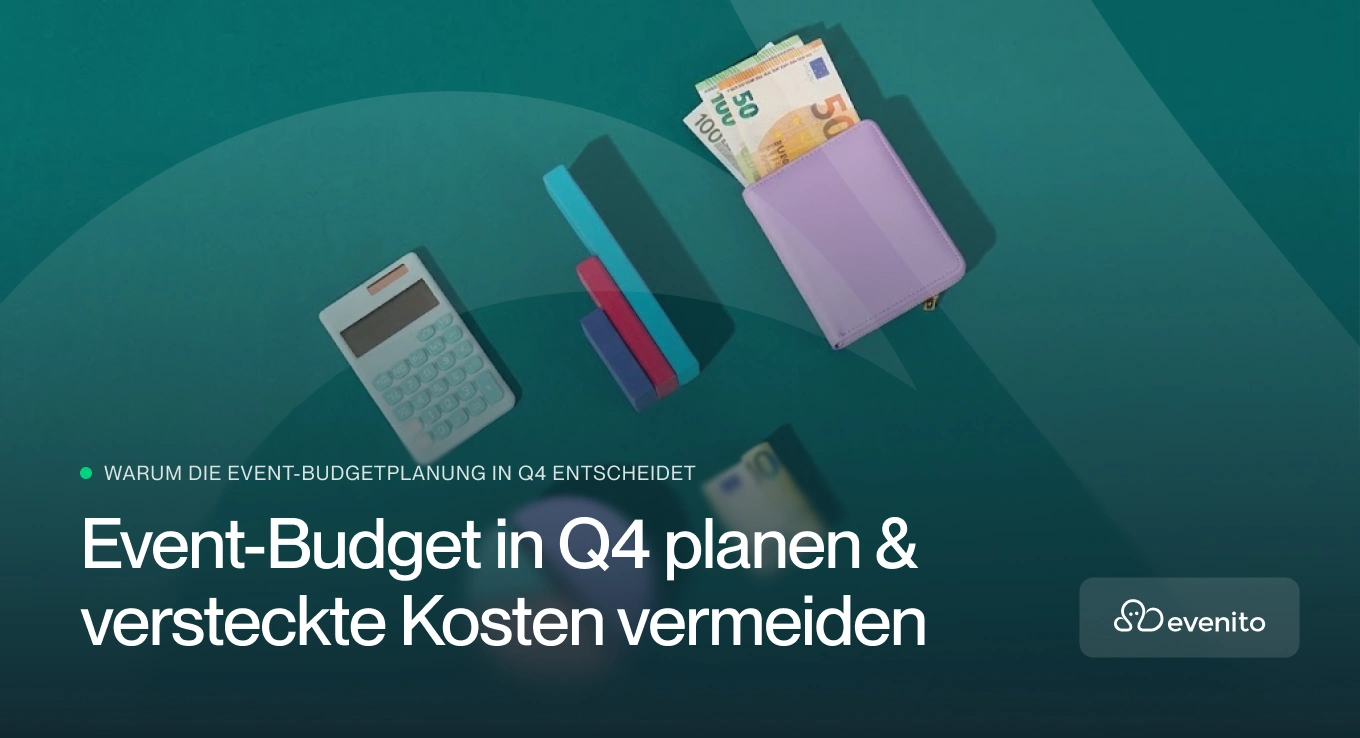
Event budgets rarely get out of hand because too little has been planned, but rather because there are too many variables involved. Participant figures change, requirements are added at short notice, processes are coordinated manually, the event is longer or the weather is not playing along. This is precisely the core of the problem and at the same time the biggest lever for savings.
Many event teams try to close budget gaps in the end: when it comes to catering, decoration or individual program items. Successful teams start their budget planning earlier. They do not reduce their costs by consciously doing without things, but by managing them better from the outset.
[Insert image]
Why event costs are often higher than necessary
In practice, create unnecessary costs usually not due to individual expensive positions, but due to a lack of transparency. If registrations are maintained in Excel, invitations run across multiple channels and there is no overview, it can be expensive. You'd rather plan too big, order too much and keep the buffer unnecessarily high.
In addition, the more complex the event is, the more people are involved. Without clear roles, standards and a central database There are frictional losses that can cost a lot of money.
The change of perspective: Controlling processes = monitoring budgets
If you want to reduce event costs sustainably, you have to shift focus. Away from individual cost items and towards the processes behind them. Because every manual step, every inquiry and every double coordination increases the risk of additional costs.
The central questions are therefore:
- How early do I know how many people are actually coming?
- How flexibly can I react to changes without renegotiating?
- How often do I rebuild things that actually already exist?
Five levers that event teams can use to save money immediately
With these 5 levers, event teams can save money right away.
1. Keep planning flexible instead of trying to secure it
Flexible contracts, variable catering models and modular technology or room concepts reduce the risk of being stuck with fixed costs.
2. Use repetition systematically
Recurring events don't have to be rethought every time. Templates, standardized processes and reusable content significantly reduce effort and costs per event, as do clear roles and responsibilities.
3. Actively manage the number of participants
Clear registration deadlines, waiting lists, automated communication and a transparent registration and deregistration process reduce no-shows and therefore unnecessary spending.
4. Move work to where it is created
When invites and contingents are managed directly by the responsible persons, there are no questions and decisions are made faster and more well-founded.
5. Use tools instead of additional service providers
Many tasks can now be carried out internally, provided that the processes are properly set up. A central event management software Like the one from evenito, it doesn't replace people, but it reduces manual work, sources of error, external dependencies and thus indirectly also the costs per event.
What does that mean for your event budget?
The cost savings for events are not the result of austerity measures just in advance, but through clear structures right from the start. If you have a good overview, you have to protect less. And who Scales processes, reduces costs per event. Anyone who manages changes in a controlled manner remains able to act, even with tight budgets.
Conclusion: With good tools, more budget remains
A good event budget is not a fixed set of figures, but reflects how structured and well-thought-out your organization is working. The clearer your processes are, the lower the risk of surprises. And the better your tools are, the more budget you have left for what really counts: events that have their full impact and win over guests.
.svg)