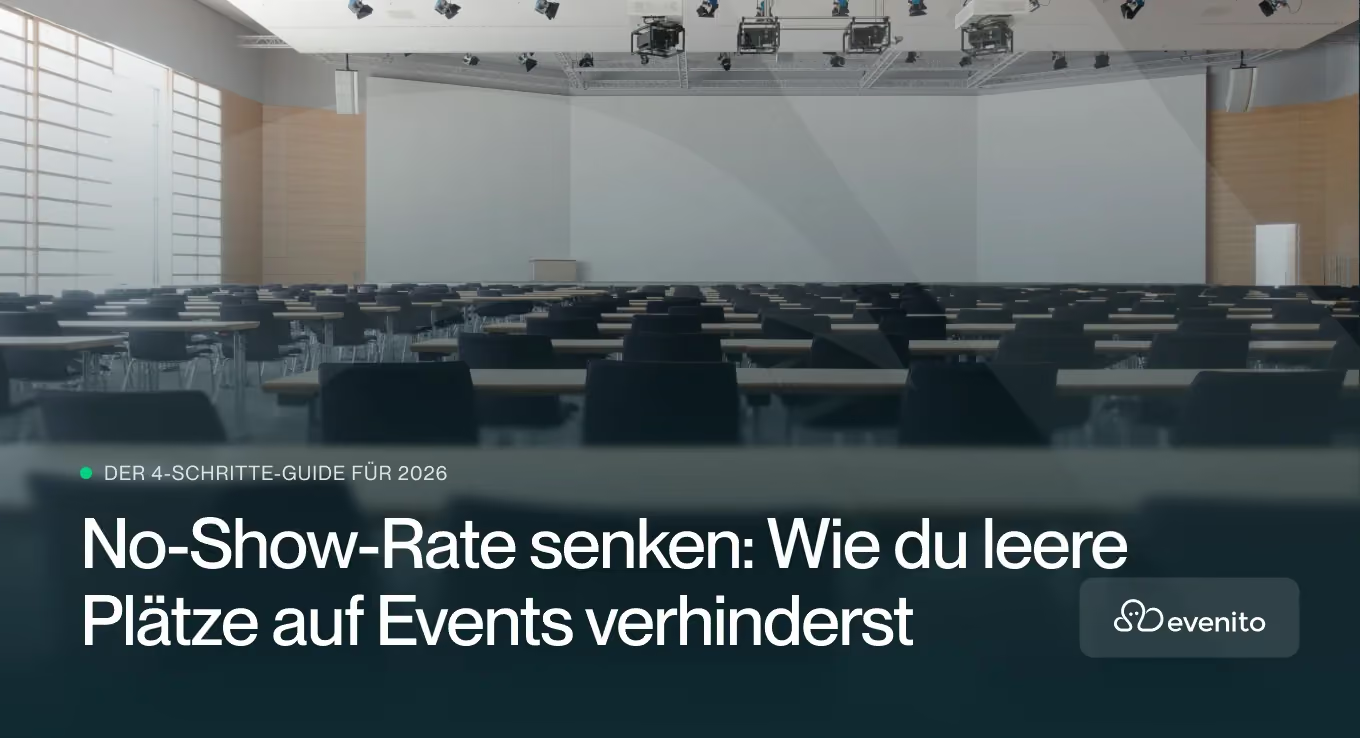
A high number of registrations is worthless if your venue is half empty on the day of the event. Many companies know the problem: registration is going brilliantly, the marketing team is celebrating its conversion rates, yet on the day itself valuable seats stay empty. A high no-show rate not only causes unnecessary costs for catering and staff, it also dampens the atmosphere on site and destroys your event ROI.
At a glance: how to halve your no-show rate The answer to empty chairs is not luck but data-driven psychology. You reduce no-shows through four strategic levers:
- Psychological commitment: activate the sunk cost effect through micro-interactions before the event.
- Multi-channel reminders: set up an automated sequence of emails and text messages.
- Smart waitlist management: refill freed-up seats dynamically and in real time.
- Data tracking: consistently analyse attendee patterns with integrated event software like evenito.
1. The hard truth: what is a normal no-show rate?
Before you take operational countermeasures, you need to know where you stand. Many event teams plan by gut feeling ("Let's just order 20% less food") instead of relying on hard metrics.
How to calculate your no-show rate
The no-show rate describes the percentage of registered people who ultimately do not attend. The formula for your analysis is:
No-show rate (%) = (registered guests − actual attendees) / registered guests × 100

Current industry benchmarks
Cross-industry data shows how much these rates vary by event format. When you analyse your own figures, compare them with these benchmarks:
- Paid on-site conferences: 10% to 40% no-shows. The financial commitment keeps the rate low.
- Free B2B roadshows and corporate events: 40% to 60% no-shows.
- Virtual live events (webinars): 60% to 70% no-shows.
For you, this means that at a free business event you lose almost every second registered guest on average if you do not actively optimise your processes.
2. The psychology behind cancellations: why guests stay away
In a B2B context, no-shows rarely happen out of bad intent. Nobody registers for an event to annoy the organiser. If you understand the reasons for not attending, you can address them precisely in your pre-event communication.
Lack of commitment for free formats
Anyone who does not have to pay for a ticket decides spontaneously on the morning of the event, depending on mood or weather. There is no noticeable consequence for staying away, so the barrier to "ghosting" is extremely low.
Shifting priorities at work
Corporate events do not compete with other events but with your guests' day-to-day business. A short-notice meeting with a manager, an urgent deadline or simple exhaustion wins the battle of priorities if your event is not perceived as truly indispensable.
Communication gaps before the event
If the value of your event does not stay top of mind after the first registration email, the date is forgotten. Guests need repeated confirmation that the trip is worth it.
3. The sunk cost effect: creating commitment without ticket fees
Why is the no-show rate so high for free events? Because guests suffer no financial loss (sunk costs) if they stay in bed. You can reverse this psychological mechanism, however, by asking for a non-financial commitment.
No-show fees are often suggested, but in B2B they tend to put off valuable leads. Use these three gentle but highly effective psychological triggers instead.
Deliberate choices (micro-commitments)
Let your guests take an active part in shaping the event. Send them a short email 14 days before the event and ask for a small decision. People who help shape something build an unconscious commitment. Examples:
- Choosing a menu preference (for example vegan or meat).
- Reserving a seat in a specific deep-dive workshop.
- Voting on a question the keynote speaker will answer live on stage.
Exclusive pre-event content (the FOMO trigger)
Move part of the event's value into the weeks before it. Send a short white paper or a teaser video from the speaker that is unlocked exclusively for registered guests. Guests consume some of the event's value in advance, and the mental barrier to cancelling rises sharply.
The donation model as a moral anchor
If you do not want to charge a no-show fee, appeal to your audience's social conscience. Communicate transparently in your emails:
- "Attendance is completely free for you."
- "Because we plan high-quality catering for every registered guest and want to avoid food waste, we donate 25 euros to [charity] for every guest who does not show up without cancelling."
- "If something comes up at short notice, just click here to release your seat."
This approach triggers a sense of social responsibility and ensures that guests at least cancel actively, which greatly improves your planning.
4. The lever: trigger the "why" and the FOMO effect
When people do not see the benefit, they stay away. Your entire pre-event communication must therefore convey crystal-clear value that outweighs your attendees' everyday work.
Position the event as an irreplaceable resource
Make your event irresistible by offering exclusive incentives and strategically using the fear of missing out (FOMO). In your mailings, answer not only "when" and "where" but above all "why":
- Which concrete, irreplaceable practical learnings will guests take back to their desks?
- Which high-profile speakers are available for exclusive Q&As that will not be recorded?
- Are there networking formats, such as moderated one-to-one matchmaking, that create business contacts you would never get on LinkedIn?
People who feel they would be at a strategic disadvantage by not attending are much more likely to show up.
5. Time multi-channel reminders strategically
A single standard confirmation email right after registration is no longer nearly enough. You need regular touchpoints to build anticipation, without annoying your audience with spam.
The optimal automated communication rhythm
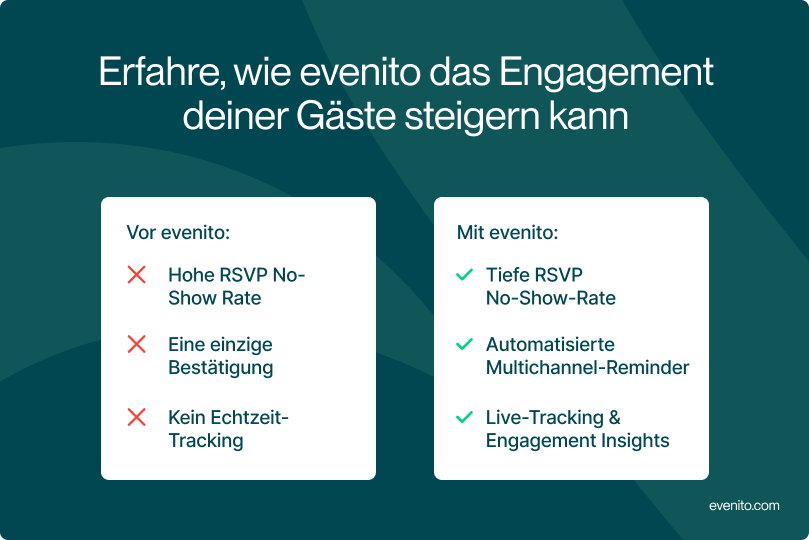
Successful event teams rely on an orchestrated, cross-channel reminder sequence. With evenito, you set up this rhythm once and it then runs fully automatically:
- 7 days before the event (the content hook): an agenda update or the introduction of a keynote speaker, to remind guests of the event's value.
- 3 days before the event (the service touchpoint): practical information on the venue, parking and travel.
- 24 hours before (the wallet pass): sending a personal digital ticket for Apple or Google Wallet. Having the ticket on your smartphone is a strong micro-commitment.
- On the morning of the event (the final push): a short text message or push notification via the event app with the first highlight of the day. Text messages have open rates of up to 98% and beat any email on event day.

6. The automated waitlist playbook: refill seats dynamically
It sounds counterintuitive at first, but it is one of the strongest tools against empty venues: make cancelling as easy as possible.
The paradox of easy cancellation
If guests have to cancel their ticket deep inside a confusing portal, they will not bother and become silent no-shows. If, however, you place a simple "Unfortunately I can't attend" button prominently in every email, people cancel actively. And that active cancellation is the starting signal for your automation.
The evenito waitlist process in detail
The real magic happens when the freed-up seat is reassigned without any manual effort. When your event is fully booked, you capture interested people on an active waitlist. This is how the automated process works in the software:
- The cancellation trigger: a guest clicks "cancel" in their reminder email. Their ticket is invalidated immediately and the venue capacity is adjusted.
- First-in, first-out automation (FIFO): the system detects the free seat and instantly notifies the first person on the waitlist.
- The 24-hour deadline: to prevent an inactive person from blocking the list, they get a clear time window, for example 24 hours, to confirm the seat.
- The loop: if they do not respond, the ticket automatically moves to the next person in line.
This dynamic process protects your catering budget and keeps your venue full, even if the theoretical no-show rate among regular registrants is 30%.
7. No-show analysis: the data goldmine after the event
Fighting empty seats does not stop when the curtain falls. The most important phase for optimising your next event is post-event reporting.
Identify patterns in the event dashboard
The no-show rate is not a fixed metric but highly dynamic. Analyse the hard facts in your evenito event dashboard:
- Time-based patterns: on which weekdays (Monday morning vs. Thursday afternoon) was the no-show rate highest?
- Audience filters: were there specific ticket categories, departments or industries with a particularly high no-show rate?
- Channel performance: did attendees who came via personal LinkedIn invitations have a better attendance rate than those from the large newsletter list?
Once you understand these patterns, you no longer plan your next events by gut feeling. You direct your marketing budget to where your most loyal guests are and remove unprofitable formats from your calendar.
Conclusion: your strategy against empty seats
A low no-show rate is not luck but the result of a clear, data-driven process. Calculate your baseline precisely to identify patterns. Trigger the psychological commitment of your guests with small tasks and exclusive content before the event.
The most important thing, however, is the logistics behind the scenes: do not try to tackle this problem with spreadsheets and manual Outlook emails. Use a professional platform like evenito to schedule multi-channel reminders reliably and manage intelligent waitlists dynamically. That way, an enthusiastic registration reliably turns into actual attendance.

Frequently asked questions about the no-show rate (FAQ)
What is a normal no-show rate for B2B events? For paid events, it is usually relatively low, between 10% and 40%. For free corporate events or B2B roadshows, however, the no-show rate quickly climbs to 40% to 60% without active countermeasures. For purely virtual events, it is often even higher.
Should you charge a fee for no-shows? A no-show fee increases commitment significantly, but it is often impractical for marketing and corporate events and can harm customer relationships. Gentler methods such as micro-commitments or automated reminder management are usually the more elegant solution in B2B.
How does event management software like evenito help prevent no-shows? evenito automates all your pre-event communication. With cross-channel email and text message sequences, simple one-click cancellations and intelligent, automated waitlist management, the platform ensures that freed-up seats are refilled immediately without manual effort.