
To the outside world, events are the perfect interplay of planning, emotion, and experience. Guests see seamless execution and a strong brand. What they often don't see is the immense pressure and mental strain on the teams working behind the scenes. This article explores why stress management is long overdue in the event industry and how companies can effectively protect their teams.
At a glance: Key takeaways for busy readers
- Low tolerance for error: Event teams work toward a fixed deadline where even the smallest mistake becomes immediately visible.
- Toxic normalization: Stress is often glorified in the industry as an unavoidable part of the job, which masks underlying structural problems.
- Resilience through structure: True stress management isn't just about enduring pressure. It requires clear processes, smart event technologies, and the elimination of shadow IT.
- Leadership responsibility: Leaders must push back against unrealistic timelines and relieve their teams by using all-in-one solutions like evenito.

Why is event management particularly prone to stress?
Stress always arises when demands and available resources are out of balance. In event management, this imbalance is almost structurally ingrained. The industry demands peak performance under extremely unpredictable conditions.
What specific stressors affect event teams?
Events are absolute moments of truth. Everything planned over weeks or months is condensed into a few hours. Mistakes are nearly impossible to correct live, and oversights are immediately visible to all guests.
Additionally, event managers must navigate the conflicting expectations of countless stakeholders. Marketing, sales, external agencies, and technical partners often have completely different priorities. The event team is caught in the middle, forced to mediate while under constant, massive pressure to make decisions.
Finally, deadlines in the event world are absolutely non-negotiable. An event happens whether everyone is prepared or not. At the same time, unpredictable events like last-minute cancellations, technical issues, or weather changes create permanent uncertainty.
What do current data say about mental health in the event industry?
The strain is not just perceived; it is measurable. In various surveys on the most stressful jobs in the world, event management consistently ranks at the top, often right behind emergency medical personnel or pilots.
This constant stress has fatal consequences for cognitive performance. Ironically, the potential for employee error rises rapidly precisely when the pressure is at its highest. Overloaded teams end up working reactively rather than strategically, which causes the quality of corporate events to suffer significantly.
Why is mental strain so rarely discussed in the event industry?
Although almost all event professionals are familiar with the feeling of chronic overload, it is rarely discussed openly in the industry. The reasons for this are deeply rooted in the work culture: stress is often equated with performance, and admitting to being overwhelmed is mistakenly seen as a weakness.
How does toxic normalization ("It's just part of the job") harm teams?
In many organizations, extreme stress in event management is considered completely normal. Phrases like "After the event is before the event" or "It's just part of the job" are the order of the day. This normalization is toxic.
It actively prevents stress from being recognized as a structural management problem. When exhaustion is glorified as a job requirement, even experienced event managers no longer dare to ask for additional resources or realistic timelines.
External success vs. internal overload: How does this conflict arise?
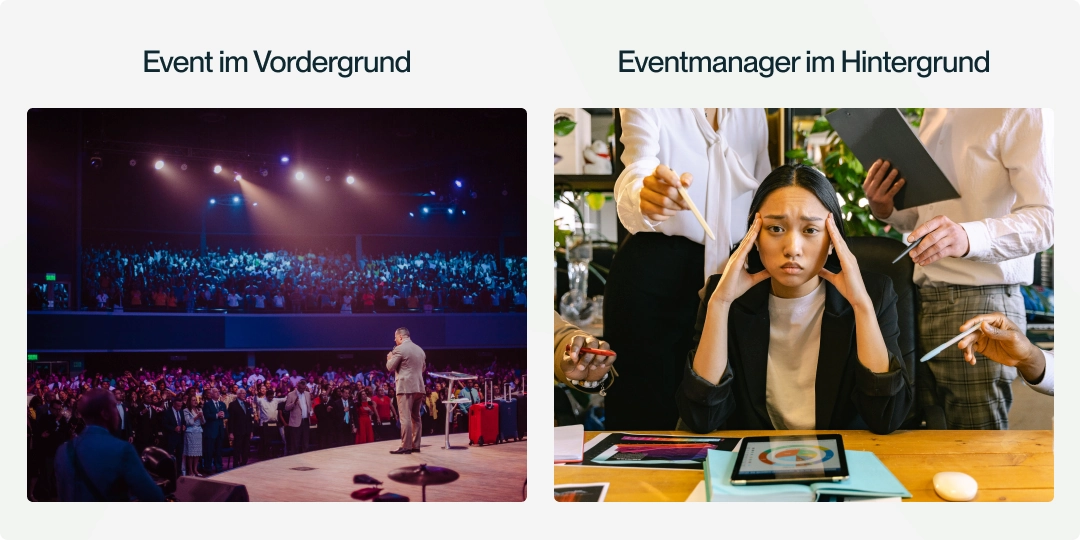
Events are the most important tool for external brand communication. Management's entire focus is on the perfect guest experience and the brand's radiance. The well-being of their own teams is pushed completely into the background.
A successful event often masks months of silent overload. The team receives praise for the glamorous final result, but not for the unhealthy way the pressure was handled along the way.
What does resilience really mean in event planning?
In the context of events, resilience is often fatally misunderstood. True resilience is not about simply enduring more pressure or becoming "tougher." Resilience means dealing with stress in a professional, sustainable way—both at an individual level and within the company structure.
How do event professionals set healthy individual boundaries?
On a personal level, resilience requires a high degree of self-reflection and assertiveness. Resilient event managers are characterized by the following behaviors:
- Realism: They set realistic expectations for themselves and the project.
- Prioritization: They strictly distinguish between "urgent" and "important" to avoid operational chaos.
- Energy management: They schedule intentional breaks and clearly communicate their capacity limits to stakeholders.
How do companies create organizational resilience?
Individual resilience is never enough if the system itself is flawed. Many stressors in the event industry are purely structural.
Organizational resilience means that a company creates a framework that minimizes stress. Resilient companies ensure clear hierarchies, standardized processes, and utilize modern softwareto establish reliable structures in an otherwise highly unpredictable environment.
In-house team vs. external agency: Who carries the higher stress risk?
When it comes to workload, the question of the setup often arises: Do companies plan events themselves or outsource them to agencies? Both models come with completely different stress profiles.
Stress factors for in-house teams:Internal teams often struggle with a lack of capacity. Event management is frequently handled "on the side" by the marketing team. The biggest stressor here is the lack of routine in event logistics and the reliance on outdated tools like Excel spreadsheets.
Stress factors for external event agencies:Agencies have the routine, but suffer from enormous pressure as service providers. They must implement the client's (company's) last-minute change requests immediately. Here, stress results from constant availability and tight, client-driven deadlines.
How can companies specifically reduce the stress on their event teams?
Stress management does not start with an obligatory after-work yoga class or a free fruit basket in the office. True resilience is built into the way events are strategically planned, operationally organized, and technologically managed.
What role do clear roles and responsibilities play?
Ambiguity in responsibilities is a massive and often underestimated stress factor. When no one on a project knows exactly who provides final approvals or is responsible for budgets, the mental strain on the entire event team increases rapidly. Clear role distribution reduces endless internal coordination efforts and prevents frustrating duplication of work.
How does standardization help with recurring event processes?
Event teams shouldn't have to reinvent the wheel for every event. Recurring processes, established checklists, and proven design templates provide enormous relief for employees. They reduce the daily cognitive load, minimize potentially fatal oversights, and give the team the necessary psychological safety during stressful peak periods.
How does modern event software relieve teams during high-pressure phases?
Fragmented tools, manual workarounds, and improvised workflows are the greatest enemies of a resilient event team. Constant manual data entry not only wastes valuable time but also causes massive mental stress.
Manual chaos vs. event platform: Where do most errors occur?
A direct system comparison clearly shows why your technological infrastructure determines your stress levels:
- Manual spreadsheets (Excel): Highly error-prone and disorganized. There are no real-time updates for last-minute cancellations, GDPR compliance is nearly impossible to guarantee, and data silos are the order of the day.
- All-in-one event platforms: Automated workflows from invitation to feedback. Centralized data storage, seamless communication, and instant updates across all channels.
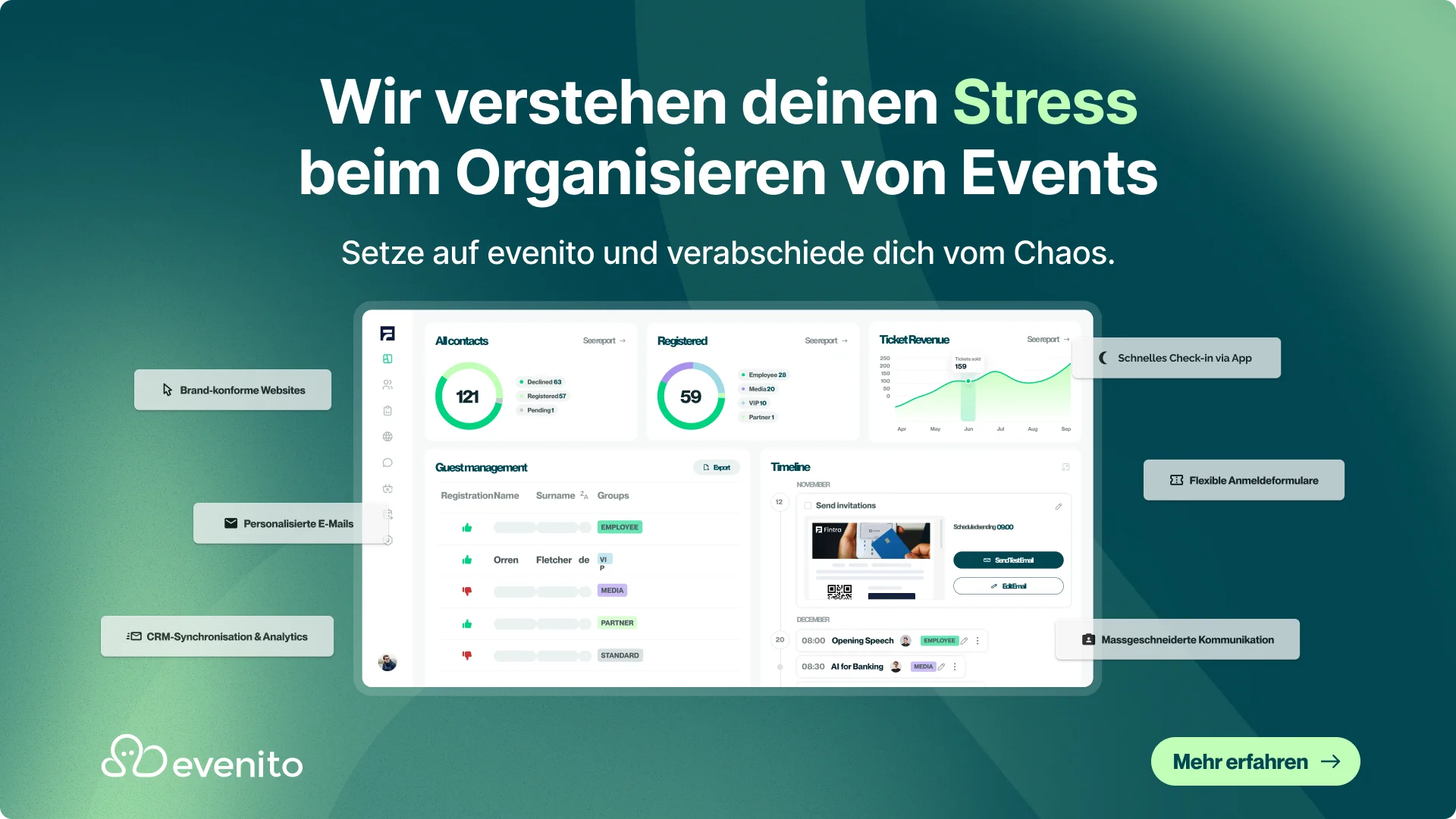
Technology should support people, not complicate their work. Intuitive event management software like evenito creates mental breathing room exactly where it is needed most. When participant management, complex ticketing and smooth on-site check-in are fully automated, event managers can finally focus on what really matters: strategic planning and the personal guest experience.
What responsibility do leaders have in stress management?
Stress management is never just an individual task; it is primarily a core leadership responsibility. Leaders significantly shape corporate culture and, by setting an example, determine how openly mental health challenges can be discussed.
How can leaders actively protect their event teams?
As a leader, you can no longer treat stress as a taboo; you must address it clearly. This creates psychological safety within the team and lowers the barrier to speaking up about emerging problems early on.
Classic, avoidable sources of stress include unrealistic timelines, arbitrarily cut budgets, and constant last-minute changes from management. A leader's most important task is to set clear boundaries here. They must act as a shield and enable the team to work with realistic goals, rather than placing additional obstacles in their path.
Equally essential is the honest recognition of performance. Celebrating successes and the hard work that goes into them is a proven way to reduce employee stress and sustainably boost motivation.
Why is a strategic rethink worthwhile for companies?
Professional stress management in the event industry is no longer just a "nice-to-have" or a soft skill topic. It is a hard-nosed, strategic success factor. Companies that actively reduce the burden on their event teams benefit on several levels:
- Higher event quality: Rested teams work more strategically, make fewer mistakes, and minimize operational risks.
- Talent retention: Experienced employees are less likely to disengage and stay with the company longer, which prevents the loss of valuable expertise.
- Strong employer branding: A healthy work culture spreads quickly in the highly competitive event industry.
- Better guest experience: Only motivated and focused teams can create truly exceptional, unforgettable experiences for guests.
Frequently asked questions (FAQ) about stress in event management
How do I recognize chronic overload in my event team?
Early warning signs of chronic stress often include increased irritability, noticeable careless mistakes in routine tasks, and a purely reactive way of working. If team members lose their strategic perspective, isolate themselves, or regularly complain about sleep problems and exhaustion, managers must intervene immediately and initiate a conversation.
How do I convince management to invest in event software to reduce the workload?
Always argue based on ROI (Return on Investment) and risk mitigation. Calculate how many working hours the team saves through automated attendee management and how expensive errors caused by manual Excel chaos (e.g., GDPR violations) can become. Demonstrate that platforms like evenito free up the capacity that is absolutely necessary for strategic event marketing.
Conclusion: Why are resilient teams the true success factor?
Corporate events and B2B trade shows are becoming increasingly complex from a technological standpoint and more prominent in their public impact. The performance pressure in this industry is not going to disappear anytime soon. The decisive competitive advantage goes to the companies that have understood how to manage this pressure.
Stress in the event industry should no longer be a taboo subject in 2026. Anyone looking to successfully create and scale events in the long term must stop talking only about wow moments and event technologies. The focus must be on the people who make it all possible in the first place. Because ultimately: Great events are not created in spite of healthy teams, but precisely because of them.
.svg)