Planning an event involves countless decisions. From the agenda and attendee communication to the right event technology, event managers have to keep track of everything. Even with a lot of experience, mistakes can happen that waste unnecessary time or diminish the guest experience.
We’ll show you 8 common event planning mistakes and how you can avoid them at your next event.
At a glance: Key takeaways for your event planning
- Decompress the agenda: Too many program items overwhelm guests. Strategic breaks are essential for networking and processing information.
- Prevent burnout: Manual Excel chaos quickly leads to team overload. Automated processes and clear responsibilities are the key.
- Choose technology wisely: Don't decide based on price alone; consider features like attendee management, integrations, and data protection.
- Encourage interaction: Replace one-way presentations with formats like live polls, Q&As, and breakout sessions to actively engage your guests.
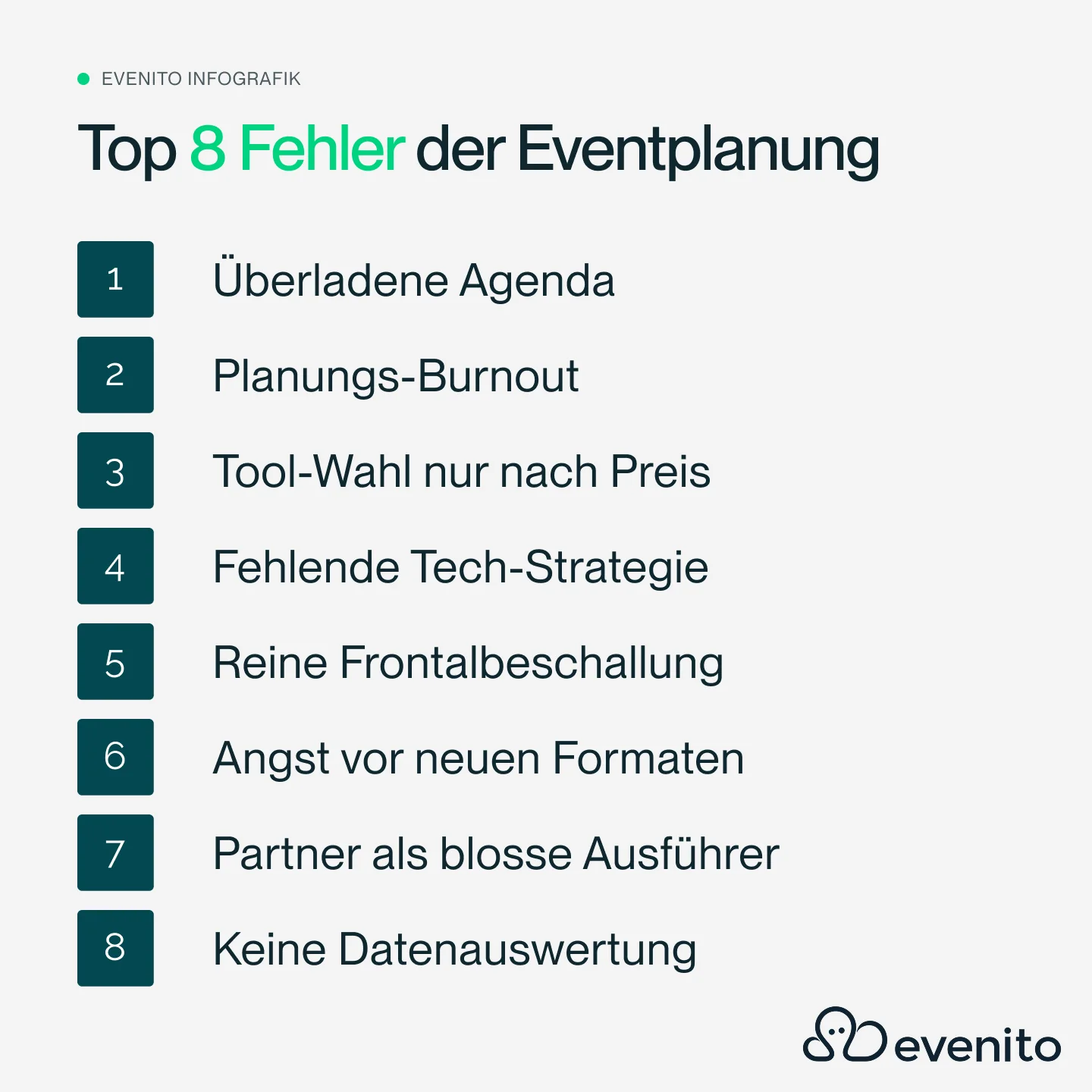
1. Why shouldn't you pack your event agenda too full?
One keynote after another, with workshops in between, and trying to squeeze in as much networking as possible: A packed program might look attractive, but it can quickly overwhelm attendees.
Therefore, plan with enough breaks and buffer time. This offers several advantages for both you and your guests:
- Your guests can process what they’ve heard in peace.
- It creates valuable time to make connections or simply switch off for a moment.
- You gain a time buffer in case a session runs longer than planned.
2. How do you avoid planning burnout on the organizer's side?
An overcrowded schedule can also become a problem for organizers. Switching between guest lists, service providers, emails, and Excel spreadsheets for weeks on end can lead to losing track of everything.
For stress-free event planning, you therefore need clear structures:
- Clearly defined team responsibilities.
- Realistic timelines.
- Ideally, as many automated processes as possible.
Digital tools can take over repetitive tasks in particular, providing much-needed relief for event teams.
3. Why you shouldn't choose event technology based on price alone
Choosing the cheapest tool is not automatically the most cost-effective decision. If features are missing, processes are too complicated, or integration options are lacking, it can lead to additional effort later on.
Therefore, define your requirements first and then check which event technology can meet them. For more complex corporate events, for example, the following criteria play an important role:
- End-to-end attendee management
- Personalization options
- Highest data protection standards
- Seamless integrations and automation
4. What are the risks of choosing the first event technology you find?
Before you start comparing platforms and making a decision, you should know exactly what you want to achieve. Should it simply help you capture registrations, or do you want to map the entire event journey digitally?
An event management platform like evenito combines key core areas into one central solution, for example:
- Event websites and registration
- Guest management and communication
- Secure on-site check-in
This allows various processes to be seamlessly linked, drastically reducing manual tasks for your team.
5. Why shouldn't you limit interaction to one-way presentations?
Whether it's a lecture, a presentation, or a keynote: even the best content loses its impact if the audience just listens passively.
That’s why you should consciously plan opportunities for participants to engage actively. The following elements turn guests into active participants and provide the necessary variety in your program:
- Live polls and Q&A sessions
- Interactive workshops
- Networking areas or breakout rooms
6. Why shouldn't you rely solely on tried-and-tested content?
Did a format work at your last event? That doesn't mean you should repeat it exactly the same way. Experiment with new formats and consider how content can be delivered in more varied ways.
The following elements can be an interesting addition to classic presentations:
- Engaging interviews
- Short, punchy insights
- Open discussions
- Interactive sessions
7. What added value do event partners offer beyond their basic services?
An agency or technology provider can do much more than just tick off a to-do list. They act as consultants, not just as an executing body. Leverage this expertise and involve your partners early in the event planning process.
Great event partners distinguish themselves by:
- Bringing in experience from many other projects
- Having a trained eye for potential problems
- Proactively suggesting new solutions
8. Why is a structured evaluation of past events indispensable?
Ignoring valuable data from the past means you are practically starting from scratch for your next event. A structured event evaluation helps you make future decisions based on real insights rather than relying solely on gut feeling.
Be sure to evaluate the following information so you don't have to start from scratch again:
- What was the registration rate for the last event?
- Which emails were opened and which were not?
- When exactly did most guests arrive?
- Which workshops were particularly popular with the participants?
Conclusion: How does conscious error prevention lead to better events?
Successful events require well-thought-out planning, appropriate technology, relevant content, and a continuous willingness to evolve.
The most important event management tips are therefore often surprisingly easy to implement:
- Plan with enough buffer time during the event day.
- Automate repetitive processes.
- Give your guests enough space to interact.
- Work in a data-driven way using insights from past events.
This allows you to specifically avoid typical event planning pitfalls while simultaneously relying on more efficient processes – for live events as well as for purely virtual and hybrid events.
.svg)