What does AI mean for the event industry?
A deep dive into opportunities, challenges and responsibility
Artificial intelligence has touched pretty much every industry in recent years, from medicine to marketing to music. But hardly any other field is as exemplary of “human encounter” as the event industry.
This is about emotions, energy, atmosphere and encounters. These are all things that are difficult to describe in algorithms. And that is exactly why the influence of AI on the world of events is so exciting and also so ambivalent. While many are still asking what AI can, the event industry has long been in the midst of practice: It uses intelligent tools to better understand guests, automate processes and personalize experiences.
But behind this efficiency lie new questions: How much automation can encounter handle? What happens when technology replaces empathy? And who actually controls the data that drives these new systems? This article takes a deep look at the role of AI in the event context, between progress and responsibility, automation and authenticity, and vision and reality.
Why AI is changing the world of events right now
In hardly any other industry are data and emotion as closely linked as in the event sector. Every click on a registration form, every session selection, and every conversation during an event generates data points. AI makes them usable for analysis, prediction and design.
The technological basis has been laid:
- language models automate communication.
- image recognition analyses emotions and movement patterns at events.
- Recommendation Engines personalize agendas or matchmaking suggestions.
- forecasting models calculate demand, visitor flows, resource planning, or catering requirements in real time.
In short: AI makes the invisible visible. And it promises to solve the biggest dilemma in the event industry: the balancing act between efficiency and experience.
AI in the here and now: Where it is already being used
When it comes to artificial intelligence, many still think of science fiction. It has long been a reality in event practice.
a) Automated communication and content creation
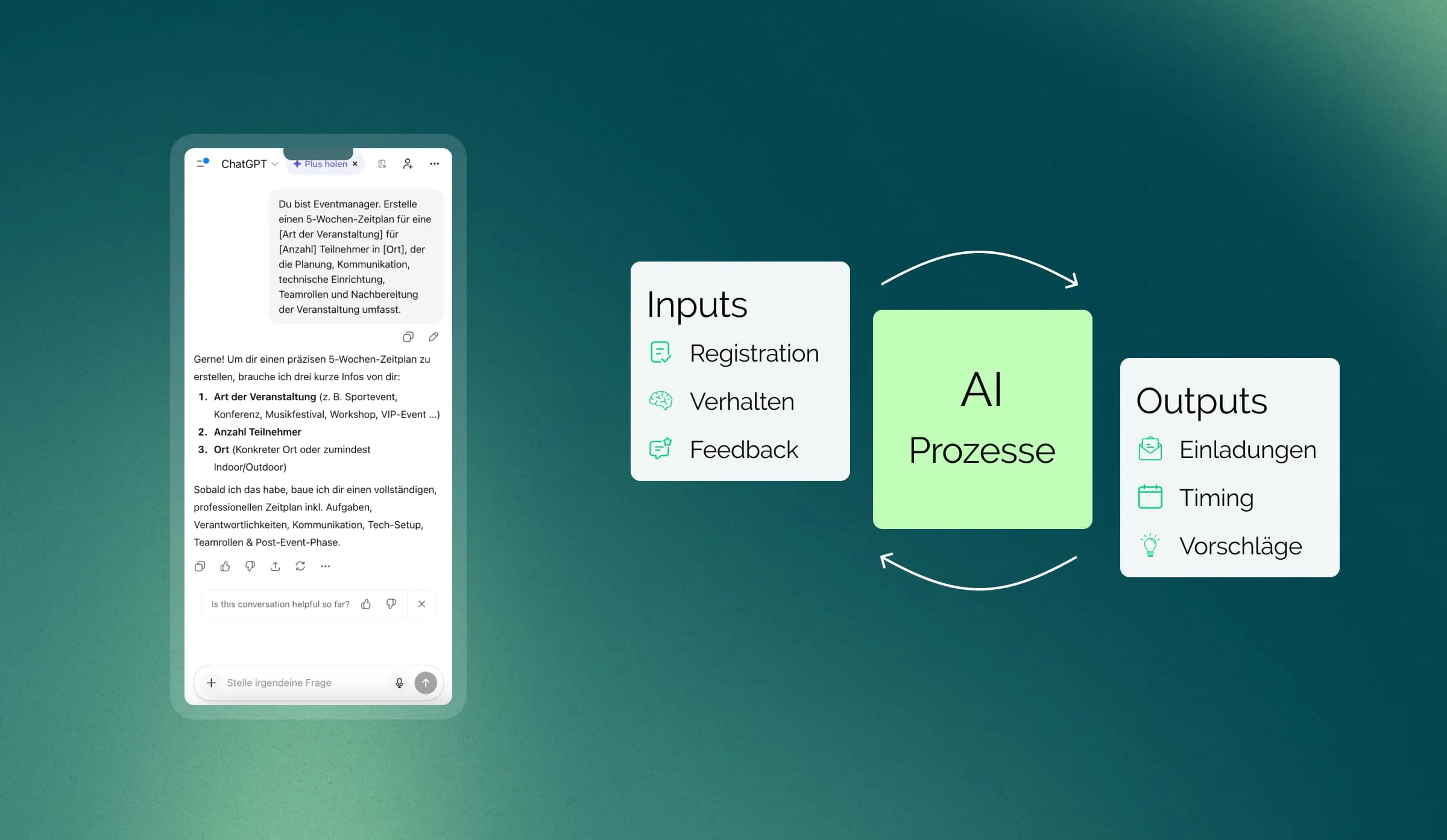
Tools such as ChatGPT or Notion AI are now used in many event teams to generate mailings, event texts, social posts and even agenda texts. They reduce pre-event marketing efforts, standardize communication and enable personalization on a large scale. Platforms such as evenito are increasingly integrating such functions directly — from automated follow-up to dynamic agenda communication.
b) Personalizing the event experience
AI helps to understand participants not as “target groups,” but as individuals. Based on interests, registration behavior, or previous events, sessions are recommended, networking matches are suggested, or content is prioritized. The result: more individual experiences, higher satisfaction and a longer commitment.
c) Predictive analytics and forecasting
Algorithms can evaluate historical data to predict attendance figures, no-show rates, or catering volumes. What used to be gut feeling is becoming a data-based decision.
d) Onsite Experience & Support
From AI-based check-ins to voice assistants to sentiment analyses from video material: AI ensures smooth processes and real-time optimization. With hybrid formats, it helps to connect virtual and physical worlds, for example through automated subtitling, translation or moderation via avatars or real-time audience analysis.
e) Post-event analysis and ROI measurement
After the event, the actual intelligence work begins: AI aggregates feedback, measures engagement, recognizes patterns and provides insights that flow directly into the next planning. What used to take hours or days now happens in seconds and opens up space for what counts: creative and human work.
Opportunities: Why AI is taking the event industry to the next level
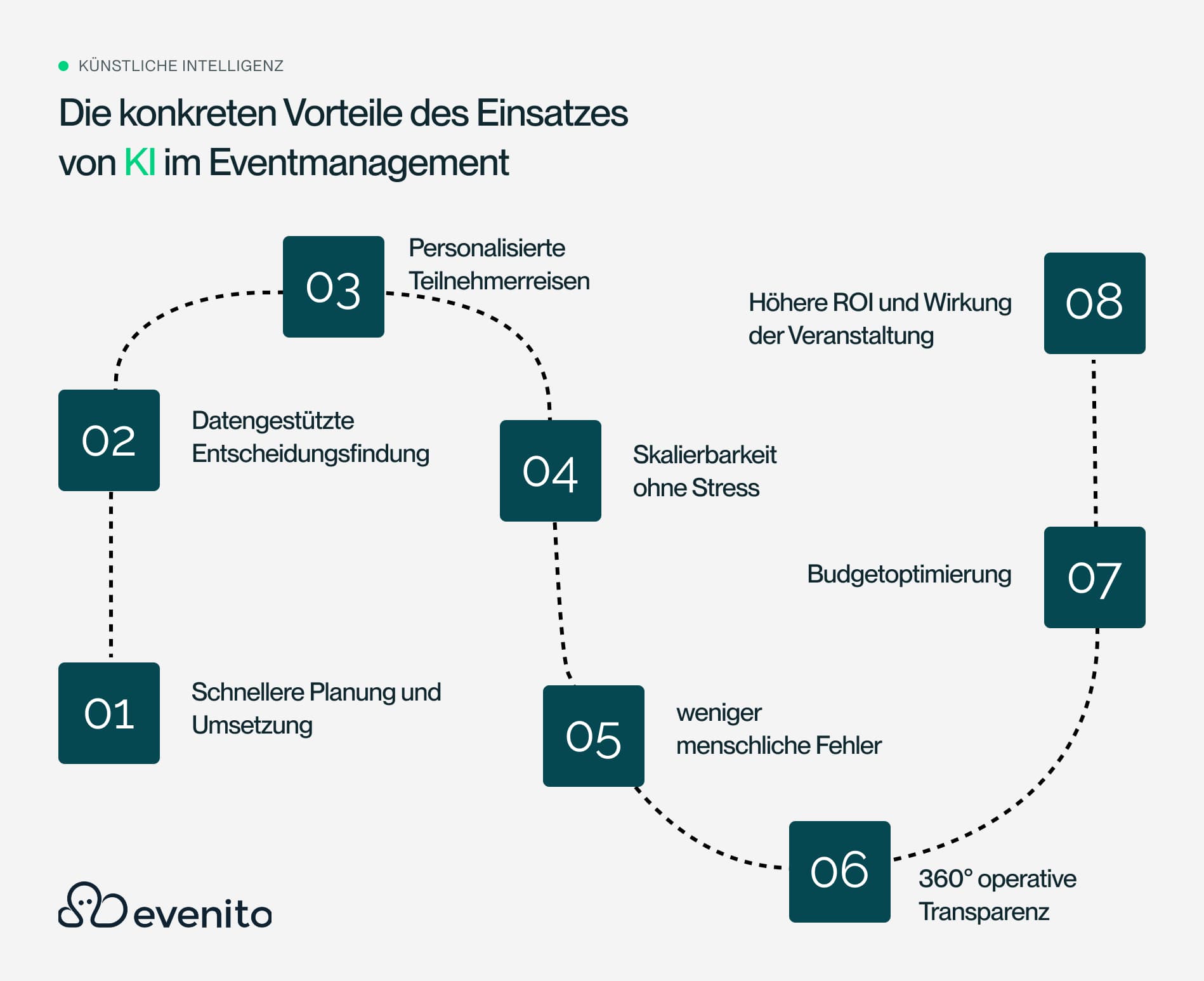
There are several explanations for why AI is driving the event industry forward:
a) Efficiency and scalability
AI relieves event teams of routine tasks such as invitations and reporting. This creates space for creative concepts, effective storytelling, targeted brand presentation and strategic partnerships. Teams can manage more events with the same team size without losing quality.
b) Precision and predictability
Through forecasts and analyses, budgets are more accurate, resources are better distributed and risks are identified earlier. For CMOs and event managers, this means: more control and measurable results. Where intuition has dominated so far, factual knowledge comes in.
c) Real-time personalization
AI translates mass events into individual experiences. A system recognizes which topics interest someone, which speakers are relevant or which networking matches make sense. This creates closeness despite size, which seemed insoluble as a paradox for a long time.
d) Sustainability through data
AI can also save resources: It analyses which materials are superfluous, which routes save energy, how catering can be planned more precisely and how emissions can be reduced overall. This saves costs and CO2.
Challenges: Where borders start
As impressive as AI is, it can't be taken for granted. The biggest risks do not arise from the technology itself, but when it is used without reflection.
a) Loss of authenticity
Events thrive on spontaneity, encounter, atmosphere and emotion. If every interaction is algorithmically “optimized”, there is a risk that everything sounds the same, looks the same, or works the same. People sense when communication is too smooth.
b) Data ethics and privacy
The more personalization, the more data. But where is the line between helpful adaptation and monitoring? Who decides which data can be used and for what? Especially in Europe, data protection is becoming a moral and legal guideline.
c) Bias and miscalculations
AI is only as good as its training data. When they are distorted, their decisions are also distorted. A system can subconsciously favor, exclude, or categorize, with far-reaching consequences for diversity and fairness at events.
d) Dependence on technology
Anyone who automates AI processes too much loses human control and situational awareness. What if the system says “no” even though the person senses that it should actually be a “yes”? AI can help, but it can't decide what a good experience is.
The philosophical dimension: What remains human?
This is where it gets exciting. Events are the opposite of code. They are a lived encounter and an uncalculated probability. And yet AI can help make these encounters more aware.
Philosophically speaking, AI in the event industry stands for a new relationship between humans and machines: People define meaning, machines create efficiency. But when machines start interpreting emotions, for example through facial expressions or voice evaluation, this line becomes blurred.
The key question is: Do we want AI to understand emotions or is it enough if it respects them?
The aim should not be to imitate people, but to strengthen and support them. AI should open up space for humanity and not replace it. It can take over routine, generate insights and simplify organization so that event teams have more time again to do what no algorithm can: read the mood. Build relationships. Create experiences.
AI as a partner, not a substitute
Practice shows that the most successful event teams do not regard AI as a competitor, but as a collaboration partner.
- Before the event: AI helps with planning, target group analysis, content creation and campaign optimization.
- During the event: It helps to steer flows of visitors and capture moods.
- After the event: It compresses data, recognizes trends, measures impact and suggests concrete measures for the future.
But the decision as to what is important and what is not remains with people. The best events are those in which technology appears invisible in the background and convinces people in the foreground.
The future: How AI is transforming event design
There are many ways in which AI can transform event design.
a) AI as a creative partner
Event concepts are already being developed together with generative tools: mood boards, visuals, room designs, name ideas. AI provides impulses, but humans choose, interpret and shape. In the future, entire event experiences could be simulated before they take place in order to test the impact, logistics and atmosphere in advance.
b) Adaptive events
Imagine: A conference whose agenda adapts to audience behavior in real time. AI recognizes which sessions are overcrowded, which topics generate resonance and where energy levels out and dynamically shifts program blocks. As a result, the event becomes a living organism.
c) Emotion tracking & experience design
With sensors and computer vision, emotions can be analyzed in order to optimize experiences. But care must be taken here. Ethics and consent must remain central. After all, experiences should be inspired and not controlled.
d) AI and sustainability
Intelligent systems can optimize emissions, transport chains, or energy consumption. The event of the future is data-based and deliberately sustainable.
Responsibility: How the industry must act now
The more powerful AI becomes, the greater the responsibility of those who use it.
The event industry should not delegate this responsibility to IT departments, but should actively shape it.
- Transparency: Participants need to know when AI is being used and in what form.
- Approval: Data collection may only take place with informed consent.
- Fairness: Algorithms should be regularly tested and retrained to avoid discrimination.
- Focus on people: AI should provide assistance and not make decisions about people.
Organizations that take these principles seriously will build trust and secure competitive advantages. Because in a world full of automation, trust is becoming the scarcest resource.
The event managers of tomorrow
The event managers of the future are no longer mere organizers. You are a data strategist, experience architect, relationship designer and ethics navigator at the same time. AI will help them plan faster, make more accurate decisions, and think more creatively. But: It doesn't replace the instinct and empathy that a great event requires.
Anyone who understands AI can use it specifically to not become less human but more human. Because that is the real opportunity of this technology: It brings efficiency to preparation, clarity to analysis and freedom to experience, taking events to the next level.
Conclusion: Between intelligence and intuition
AI is profoundly and irreversibly changing the event industry. However, it is not uncontrollable. It forces us to redefine what creativity, encounter, planning and experience mean. The future belongs to event teams who see technology as a tool and not as an end in itself, who use data to create closeness and program the algorithms to make emotion possible. Or, to put it in one sentence: The future of events is not artificially intelligent, but humanly smarter.
.svg)